Small-Parcel Consolidation Tool: How to Combine Multiple China Packages Into One Shipment
Editor:
Last Updated: 2026-01-20 CST
Table of Contents
If you are buying from Chinese marketplaces, you often end up with several small parcels rather than a single clean shipment. Each parcel has its own tracking number, packaging style, and shipping cost profile. A small-parcel consolidation tool is the practical way to turn that mess into a single, predictable outbound shipment-while keeping costs, risks, and timing under control.
This guide explains what a small-parcel consolidation tool actually does, how to use it step by step, when it saves money, when it doesn't, and how to avoid the mistakes that cause delays or damage.
If you want a practical walkthrough inside KongfuMall, follow our one-click parcel consolidation guide and consolidate multiple parcels into one shipment.
What Is a Small-Parcel Consolidation Tool and Why Do Buyers Use It?
A small-parcel consolidation tool is a workflow that helps you manage multiple inbound packages, bring them into a single location (usually a warehouse), and combine them into a single outbound shipment. The "tool" part is not only software. It is the whole process:
tracking inbound parcels
confirming arrivals
grouping orders
selecting repacking options
calculating shipping by weight/volume
generating the final outbound label
Buyers use it because the default experience is inefficient: shipping multiple parcels separately can be expensive, hard to track, and challenging to receive smoothly.If you're new to this workflow, China buying agent explained shows how receiving, inspection, consolidation, and dispatch connect end to end.
What problem does consolidation solve?
It solves three daily problems:
Cost unpredictability: You don't know your final shipping total until each parcel ships separately.
Tracking overload: Too many tracking numbers lead to more delivery mistakes and missed deliveries.
Packaging mismatch: The China seller's packaging is optimized for domestic delivery, not long-distance international handling.
A small-parcel consolidation tool doesn't guarantee lower costs. It ensures control-and control often leads to savings.
How Does a Small-Parcel Consolidation Tool Work in Real Life?
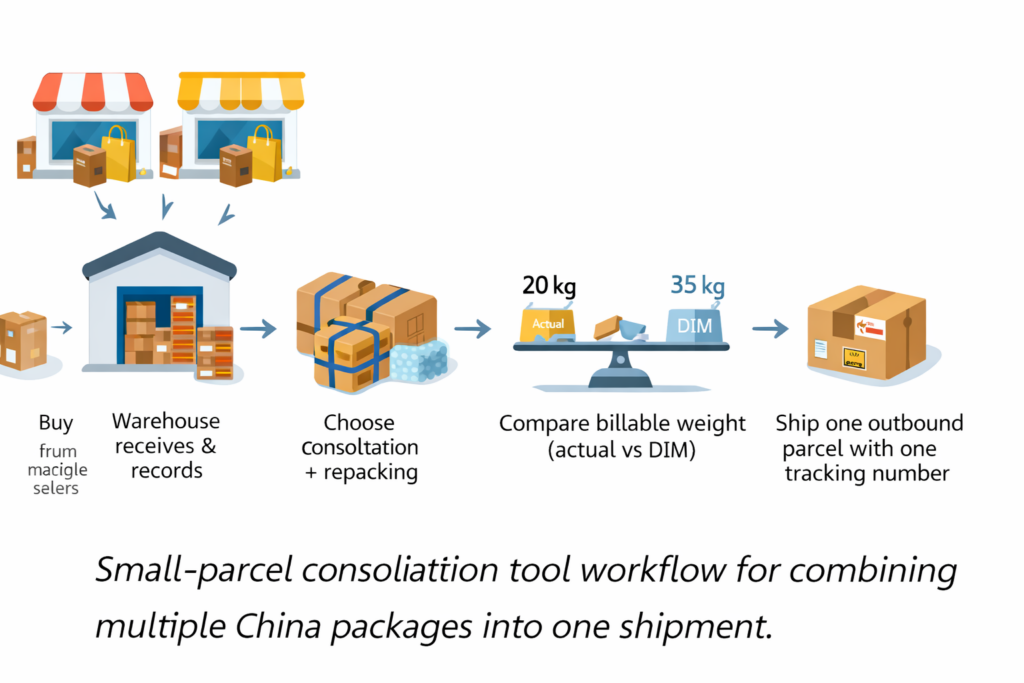
Think of consolidation as a "hub-and-spoke" model:
Sellers ship your orders to a warehouse address in China.
The warehouse receives each parcel and records the details.
You decide which parcels to combine, repack, or protect.
One consolidated carton is shipped to you internationally.
What does the tool track?
A functional small-parcel consolidation tool typically tracks:
Without these elements, consolidation becomes guesswork. And guesswork is how people lose time or break items.
When Should You Use a Small-Parcel Consolidation Tool?
A small-parcel consolidation tool is most useful when you have multiple small orders that are individually cheap to ship domestically, but costly to ship internationally one by one.
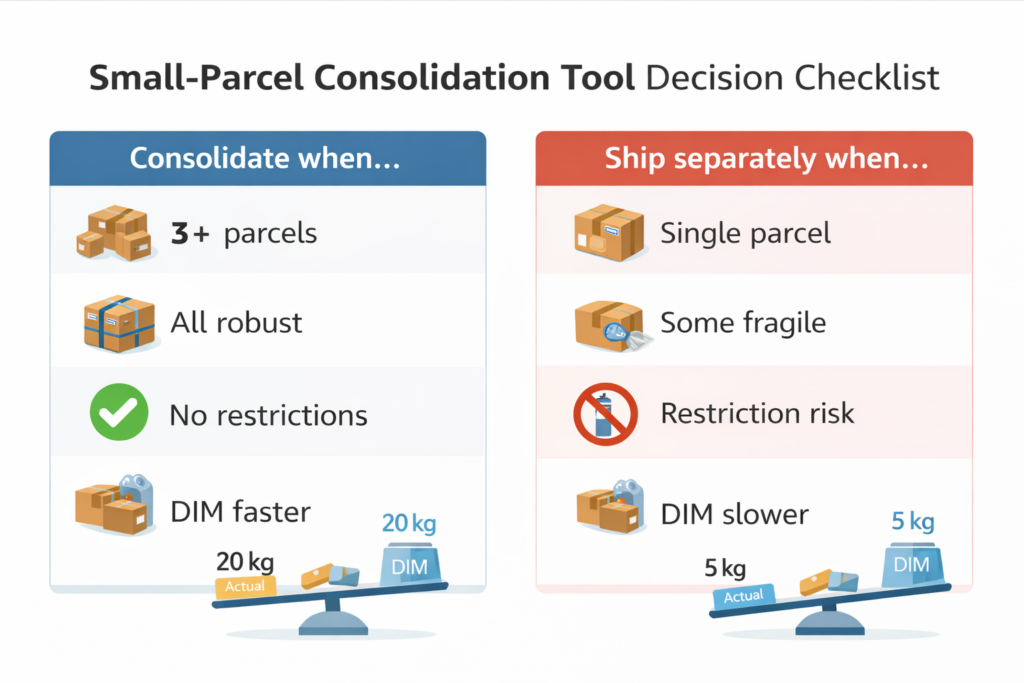
Use consolidation when these are true.
You have 3+ parcels coming within a short time window.
Items are lightweight but bulky (packaging matters).
You want one delivery instead of multiple drop-offs.
You need a controlled repack for protection or customs clarity.
Avoid consolidation when these are true.
You need one item urgently (shipping separately may be faster).
Items are high-fragility and safer when shipped in their original retail packaging.
The parcels are already near-optimal in size/weight for the shipping tier.
You are shipping restricted categories that require special handling.
In other words, the tool is strongest when you are optimizing a system, not when you are rushing a single item.
Step-by-Step: How to Combine Multiple China Packages Into One Shipment
This is the workflow most buyers should follow. The exact interface differs across services, but the logic stays the same.
Step 1: Collect the inbound tracking numbers
As soon as sellers ship, save:
domestic tracking number
seller name/store
item description (for your own reference)
expected arrival date
If you skip this, you'll later struggle to match parcels to orders. A small-parcel consolidation tool is only as clean as your inbound records.
Step 2: Confirm warehouse arrivals and verify the basics
Once parcels arrive, check:
The quantity received matches your expectation
packaging condition (crushed, torn, wet, open)
visible label accuracy (name, warehouse code, order ID)
If your service provides photos, scan for obvious issues before you combine anything.
Step 3: Decide your consolidation group (what goes together)
Group parcels based on:
fragility: fragile with fragile, not with heavy metal parts
Customs clarity: similar category items together can simplify declarations
Risk tolerance: separate the "must-arrive-perfect" item if needed
box efficiency: avoid awkward shapes that waste volume
A good small-parcel consolidation tool makes grouping obvious-a bad one forces you to guess.
A small-parcel consolidation tool should show you either:
estimated actual weight and dimensions, or
a shipping quote after repack is completed
If the tool provides no visibility, you are operating in the dark.
FedEx also clarifies that you're charged by dimensional weight or actual weight-whichever is greater-see FedEx dimensional weight.
Step 6: Confirm declaration details and ship as one parcel
Before paying, verify:
recipient name and address format
declared contents are accurate and consistent
shipping method matches your risk and timeline
Then you pay once and receive one outbound tracking number-the single point of truth for the final delivery.
Will a Small-Parcel Consolidation Tool Actually Save You Money?
Sometimes yes, sometimes no. The correct answer depends on your parcel mix.
For real examples of how consolidation reduces duplicated packaging and volumetric weight, see our Taobao package consolidation breakdown.
Why can consolidation reduce costs?
Consolidation can lower costs by:
Reducing total volume through box removal
combining multiple "minimum charge" parcels into one shipment
preventing repeated handling fees across separate shipments
creating a cleaner, denser carton that ships more efficiently
Why consolidation can increase cost
It can increase cost when:
Your combined carton crosses a higher weight tier
You add heavy protection materials unnecessarily
You choose double-boxing without real need
The final dimensions trigger high volumetric weight billing
A small-parcel consolidation tool is valuable because it lets you see and choose rather than guess.
What Are the Most Common Mistakes Buyers Make?
Many buyers think consolidation is automatic. It is not. It is a decision process.
Mistake 1: Consolidating everything into one giant box
A huge box can create:
volumetric weight problems
Higher damage risk from internal movement
Higher customs attention due to size
Sometimes two medium cartons are safer and not much more expensive.
Mistake 2: Removing packaging that protects fragile items
Some seller boxes are "waste." Others are structural.
If you remove rigid inserts, molded trays, or corner protection, you might save a small amount, but you'll massively increase the risk of damage.
Mistake 3: Mixing heavy and delicate items
Heavy items shift during transit. If you consolidate them with delicate items, damage becomes likely even with padding.
Mistake 4: Waiting too long and paying storage fees
Consolidation works best in a time window. If you wait for a final parcel that keeps delaying, your early parcels may start incurring storage fees.
A good small-parcel consolidation tool clearly shows a timeline and storage policy.
Mistake 5: Not checking restrictions before shipping
Some items are restricted or require special handling depending on the destination country. If you consolidate restricted items into the same shipment, you may lose the entire parcel.
Before you combine parcels, review prohibited items to avoid consolidating goods that require special handling or may be blocked.
How Do You Decide the Best Repacking Level?
Repacking is not "more is better." It is "right-fit."
Use light repack when:
Items are non-fragile (clothing, soft goods)
Seller's packaging is bulky and wasteful
Your main goal is to reduce volume
Use reinforced repack when:
Items have breakable parts
You see weak cartons, crushed corners, or loose internal packing
The shipment will travel through multiple hubs
Use separate cartons when:
One item is high-value or high-risk
You have liquid/gel/battery categories
You have heavy plus fragile items
A small-parcel consolidation tool should let you apply different options per parcel or per group, not force one setting for all.
How Long Does Consolidation Take?
Timing varies by service, but the process is predictable if you plan.
Typical timeline:
Inbound parcels arrive over 3–10 days
warehouse processing and repack: 1–3 days
outbound shipping: depends on method (economy vs express)
You control most of the delay by deciding:
How long do you wait for late parcels
whether you need photos/QC before shipping
whether repacking is simple or complex
What Should You Look For in a Good Small-Parcel Consolidation Tool?
Not all tools are equal. The best ones reduce uncertainty.
Must-have features
clear inbound tracking list with timestamps
parcel photos or condition notes (optional but valuable)
easy grouping into consolidation batches
Repack options explained in plain language
visible weight/size information or reliable quoting
a single outbound tracking number after shipment
Nice-to-have features
pre-scan and item verification
packaging removal choices (outer box vs inner box)
insurance options
automated reminders before storage fees start
If a tool hides information, you will pay in surprises.
FAQ: Small-Parcel Consolidation Tool
Is consolidation safe for international shipping?
It can be safe when you match repacking to item type and avoid mixing heavy and fragile goods. The main safety risk comes from removing protective structure or under-padding.
Does consolidation always reduce shipping costs?
No. It often reduces volume, thereby lowering costs. But if the final carton crosses a weight tier or triggers volumetric weight, cost can rise. The benefit is control and predictability.
Can I consolidate parcels from different sellers?
Yes. That is one of the primary reasons to use a small-parcel consolidation tool. The warehouse receives packages from multiple sellers and combines them into a single outbound shipment.
Should I consolidate batteries, liquids, or restricted items?
Be careful. Many destinations treat these categories differently. If your shipment includes restricted items, you may need a special method or separate shipping. Consolidating them can increase risk.
What is the most straightforward beginner workflow?
A clean beginner approach is:
Consolidate only soft goods first (clothing, accessories).
Use a light repack to reduce volume.
Avoid fragile items until you understand repack quality.
Track timing to avoid storage fees.
Final Takeaway: Use a Small-Parcel Consolidation Tool as a Control System, Not a Shortcut
A small-parcel consolidation tool is not magic. It is a control system for cross-border buying. It helps you track inbound parcels, group them logically, repack wisely, and ship a single predictable carton instead of many chaotic ones.
If your goal is fewer deliveries, cleaner tracking, and more predictable shipping outcomes, this workflow is one of the most practical upgrades you can make. Use it intentionally, and you'll reduce surprises-whether your final cost goes down or becomes more stable and easier to plan.
We use cookies to enhance your browsing experience, serve personalised ads or content, and analyse our traffic. By clicking "Accept All", you consent to our use of cookies.
Cookie Policy
Customise Consent Preferences
We use cookies to help you navigate efficiently and perform certain functions. You will find detailed information about all cookies under each consent category below.
Loading cookie preferences...
Language Settings
The current browser language is
.
Do you want to switch the website to this language